Google search


Wednesday, October 31, 2007

Ha Noi culture(Part 1):Vietnamese Water Puppet

Mua Roi Nuoc - Vietnamese Water Puppet
Host unlimited photos at slide.com for FREE!


Mua Roi Nuoc or Water Puppet is a unique art which has it origin in the delta of the Red river in the tenth century. The farmers in this region devised a form of entertainment using what natural medium they can find in their environment. In ancient times, the ponds and the rice paddies after harvest were the stage for these impromptu shows. This art form is unique to North Vietnam and only finds its way to the world stage in recent years as a result of the normalized relation with the West. Today the Thang Long puppet troupe is the most well known in Ha Noi.
Host unlimited photos at slide.com for FREE!

Modern, water puppetry is performed in a pool of water with the water surface being the stage. The puppeteers stand behind a screen and control the puppets using long bamboo rods and string mechanism hidden beneath the water surface. The puppets are carved out of wood and often weigh up to 15 kg. A traditional Vietnamese orchestra provides background music accompaniment. Singers of Cheo (a form of opera) with origin in north Vietnam sing songs which tell the story being acted out by the puppets.

Vietnamese Water Puppet show 1


The theme of the skits is rural and has a strong reference to Vietnamese folklore. It tells of day-to-day living in rural Vietnam and Vietnamese folk tales that are told by grandparents to their grandchildren. Stories of the harvest, of fishing and of festivals are highlighted. Legends and national history are also told through short skits. Many of the skits, especially those involving the tales of day-to-day living, often have a humorous twist.


Vietnamese Water Puppet show 2

Tuesday, October 30, 2007

Ha Noi beauty-spots(Part 5):West Lake or Ho Tay

Host unlimited photos at slide.com for FREE!

Ho Tay is the largest of all the lakes in Ha Noi. The lake is on the northwest part of the city. Long ago, the lake was a branch of the Red river but later, as the river changed course, the lake remained a body of water just west of the river. There are many legends associated with West Lake. The most popular is the legend of the golden buffalo.

Host unlimited photos at slide.com for FREE!
As the story goes, there once was a medicine man who was a giant. He is well known in Vietnam for his medicine practice and the king often used him to treat the royal family. His fame reached China and he was invited to China to treat the king. He was successful where others have failed so the king was going to reward him with great wealth. He refused offerings of gold and only requested that the king give him all the black copper in the king's vault. The king agreed and the giant left for Vietnam with vast amounts of black copper. In Vietnam the giant molded a giant bell of black copper. The giant rang the bell and the sound resonated all the way to China. In the king's vault there was a golden buffalo. Upon hearing the sound of the bell, the buffalo came to life (because he thought that his mother was calling him) and charged southward. Upon reaching Ha Noi, the buffalo trampled the land in the area near Red river. Over the years, this area filled with water and became Ho Tay or West Lake.
Ho Tay has always been an area for vacationing royalties. When Ha Noi was still the capital city, the kings from the Ly and Tran dynasty built summer homes along the lake. In the north end of the lake there are several villages famous for their flowers and fruits plantations. Most famous is Nghi Tam village, the birth place of Ba Huyen Thanh Quan, one of Vietnam's premier Poetess.
(From vietscape)
Host unlimited photos at slide.com for FREE!

Ha Noi beauty-spots(Part4):Museum of Fine Arts

Host unlimited photos at slide.com for FREE!
Located at 66 Nguyen Thai Hoc Street, the museum began receiving visitors on June 24, 1966. One of Vietnam's comprehensive display of architectures, sculptures, drawings, and fine arts is housed at the museum. The museum also contains displays of the ethnic minority people in Vietnam. Stone ax blades, stone sculptures, statues and ornaments, Muong skirts, belts, and Tay Nguyen bronze rings are some of the few items on display.
Host unlimited photos at slide.com for FREE!

Visitors are able to see works of art dating to the stone and bronze ages. Stone rings, earings and necklaces are evidence of a civilization dating back 2,000 to 3,000 years. The bronze statues, drums, and ornaments on display bring the visitors closer to that part of history that is rich with tradition and culture.

(From vietscape)
Host unlimited photos at slide.com for FREE!


Items from Museum of Fine Arts

Monday, October 29, 2007

Ha Noi beauty-spots( (Part3):Van Mieu - Temple of Literature

Originally built in 1070 in the Ly dynasty, the temple is a shrine to Confucius and his disciples responsible for spreading his teachings. Six years later, Quoc Tu Giam or School for the sons of the Nation was established for the princes. The school later admitted sons of mandarins and finally commoners were allowed to attend but, only after they passed a rigorous examination at the regional level. In 1484, Van Mieu became a place to memorialize the most brilliant scholars of the nation.


Host unlimited photos at slide.com for FREE!

Host unlimited photos at slide.com for FREE!
In 1484, King Le Thanh Tong decreed the names of all those who have attained the doctoral ranks in the national examination be inscribed on stone stelae carried on the backs of giant tortoises. In all, 2,313 individuals were awarded the title of tien si. However, detailed records were kept only between 1442 and 1779 . According to records, there should be 112 stelae in all but only 82 stelae are still standing. Each represents a single examination year. The name and native village of the students who were awarded the title Tien Si or doctor laureate were inscribed on the stone. Tien si was not a diploma of graduation from the royal college. This title was awarded to those who have successful passed the 4 royal examinations. Scholars from all over Vietnam could participate only if they had passed the regional exam.

Host unlimited photos at slide.com for FREE!
Courtyard of the Sages is located beyond the Garden of Stelae. Entrance to the courtyard is through Dai Thanh Mon or Gate of Great Success. The Great House of Ceremonies is located here. It was here that all new doctor laureates would come to pay respect to Confucius. The king would also come to pay homage to the great teacher at Dai Thanh Mon. Inscribed on a wooden panel above the altar are the words "Teacher of Ten Thousand Generations".

Behind the Great House of Ceremonies is the Sanctuary, with statue of Confucius flanked by his four closest disciples, Nhan Tu, Tu Tu, Tang Tu, and Manh-Tu (Mencius).

Quoc Tu Giam or School for the Sons of the nation is located in the last courtyard. During the time when Van Mieu was used as a school, this area housed classrooms, housing facilities and a print shop. When the university was moved to Hue, Quoc Tu Giam was turned into a shrine to Confucius' parents called Khai Thanh.


Van Mieu slide

Sunday, October 28, 2007

Ha Noi beauty-spots (Part2) :One Pillar Pagoda

Host unlimited photos at slide.com for FREE!

Host unlimited photos at slide.com for FREE!


C
hua Mot Cot or the One Pillar Pagoda has become the symbol of Vietnamese rich culture and history. The pagoda was built in the reign of king Ly Thai Tong (1028-1054). According to legend, in his dream, in 1049, the king saw a vision of Phat Ba Quan Am - Kwan Yin. She led him to a shrine in the middle of a lotus pond. When he woke up, he consulted with his court and decided to replicate the shrine in his dream to dedicate it to Kwan Yin. The One Pillar Pagoda resembles a giant lotus blossom.


A narrow flight of stairs leads to the tower where there sits a gilded figure of Quan Am, to whom the pagoda is dedicated
Host unlimited photos at slide.com for FREE!
The altar in the small shrine
A gilded figure of Quan Am sits in the dim interior upon lotus blossoms. The lotus throne in Buddhist iconography is reserved for those who have obtained "perfect comprehension."

Host unlimited photos at slide.com for FREE!


One Pillar Pagoda in 3d world

Ha Noi beauty-spots(Part1) :Lake of the Returned Sword

Lake of the Returned Sword_Ho Hoan Kiem (Ho Guom)


Host unlimited photos at slide.com for FREE!

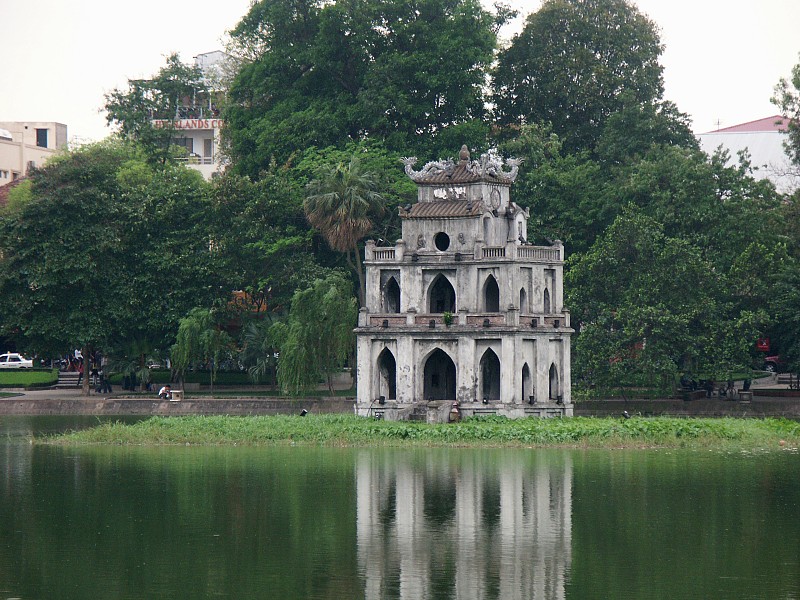
The Tortoise Tower on an island in the lake


Ho Hoan Kiem or Lake of the Returned Sword was once a part of the Red river (song Hong). Through thousands of years of changes in the geography, the lake moved eastward to its present position many kilometers from the river. The lake was once called Luc Thuy or Green Water because the water was green year round. In the fifteen century, the lake was named Ho Hoan Kiem, based of a legend that is quite similar to King Arthur and the Lady of the Lake's legend.

While fighting against the Chinese, King Le Thai To has in his possession a very valuable sword. After 10 years of continuous struggle, the King finally defeated the Chinese and reclaimed Vietnam's independence. One day, while sailing on lake Luc Thuy, a large turtle appeared. The king drew his sword and pointed at the creature. The turtle immediately grab hold of the sword with its mouth and submerged. The king mourned the lost of such valuable sword, demanded that the lake be emptied and dredged. Both the turtle and the sword were not found. The king realizing that the gods must have lent him the sword to drive back the enemy, but now that Vietnam is free, the sword must be returned. King Le Thai To named the lake Ho Hoan Kiem or Lake of the Returned Sword.

Host unlimited photos at slide.com for FREE!

Host unlimited photos at slide.com for FREE!

Since the reign of king Le Trung Hung (XVI century), every king in the Le dynasty, and Lord Trinh have all contributed to the beautification of the lake. Lord Trinh Giang built Khanh Thuy shrine on Ngoc island on the north end of the lake. He also had the two man made hills built across from Ngoc son Shrine.

At the end of the Le Dynasty, Khanh Thuy was destroyed by Chieu Thong. A philanthropist named Tin Trai built Ngoc Son pagoda. Ngoc Son pagoda was renamed Ngoc Son shrine during the reign of Thieu Tri III (1843) because it was no longer a Buddhist shrine. Instead, Ngoc Son is a shrine to Van Xuong, a deity, in charge of literature and the various tests required to become a mandarin. It is also a shrine to general Tran Hung Dao, a national hero responsible for many victories against the Mongols.
Host unlimited photos at slide.com for FREE!
The Huc bridge

Host unlimited photos at slide.com for FREE!

Ngoc Son temple

Host unlimited photos at slide.com for FREE!
Ngoc Son temple(night)

Since then Ngoc Son has gone through many renovations, one of which was the addition of Thap But (Pen Tower) on the hill which was once called Dao Tai. Three words inscribed on the tower "Ta Thien Thanh" or "write on blue sky". Inside the gate a pool resembling the shape of an ink well was added. Beyond the ink well is The Huc bridge or "where the sun light is absorbed". The bridge leads to Dac Nguyet Lau or "Moon Light tower" - Ngoc Son shrine. Beyond the gates to the shrine, there are two walls called bang Rong and bang Ho (dragon and tiger slate) where the names of those who passed the national test are inscribed.

On the southwest end of the lake is Thap Rua. It was rumored that king Le Thanh Tong used to fish here. Lord Trinh also built the structure to house his entourage while visiting the lake.
(Information from vietscape)


Ho Guom video from a traveler......

To be continued.............

Friday, October 26, 2007

Ha Noi--Our beautiful capital

Ha Noi,capital of Viet Nam.A large city.
Host unlimited photos at slide.com for FREE!
Hoan Kiem Lake-Hanoi


Hanoi , estimated population 3,145,300 (2005), is the capital of Vietnam. From 1010 until 1802, it was the political centre of an independent Vietnam with a few brief interruptions. It was eclipsed by Huế during the Nguyen Dynasty as the capital of Vietnam, but served as the capital of French Indochina from 1887 to 1954. From 1954 to 1976, it was the capital of North Vietnam.

The city is located on the right bank of the Red River. Hanoi is located at 21°2' North, 105°51' East, 1760 km (1094 mi) north of Ho Chi Minh City
Host unlimited photos at slide.com for FREE!


Ha Noi in literature
Most Vietnamese and Westerners are familiar with the phrase Ha Noi ba muoi sau Pho Phuong or Ha Noi 36 districts. This phrase often causes much confusion for most people since, on the one hand Pho means a street or a place for merchants to gather to do business, on the other hand Phuong means a district or a guild of artisans specializing in a particular trade (phuong cheo, phuong tho, etc.). In any case, there is some truth to the use of both descriptions.


Host unlimited photos at slide.com for FREE!

Similar to the Guilded age of Europe, Ha Noi's 36 districts is Vietnam's version of the guild concept. Long ago, as artisans moved to the capital city to do business, they gathered together in an area as a way to share resources. As a result, many of the streets are named after the crafts that were sold on that street. Pho Hang Bun (Vermicelli), Pho Hang Ma (paper product), Pho Hang Bac (Jewelry) are a few of the streets carrying the name of the products sold on the street.

Host unlimited photos at slide.com for FREE!

Today, the 36 pho or old district remains in Vietnamese literature as a quaint and familiar description of this part of Ha Noi. Although many of the streets no longer have the products for which they were named, some still do. Today, on many of the streets, there are still shrines dedicated to the individual diety of the trades for which the streets are named.


Host unlimited photos at slide.com for FREE!


Ha Noi video clip from a traveler
To be continued........

Viet Nam----The Profile

What do you know about Viet Nam---My country????


Host unlimited photos at slide.com for FREE!


CapitalHanoi
21°2′N, 105°51′E
Largest cityHo Chi Minh City
Official languagesVietnamese
DemonymVietnamese
GovernmentSocialist republic1
- PresidentNguyễn Minh Triết
- Prime MinisterNguyễn Tấn Dũng
- General SecretaryNông Đức Mạnh
Independencefrom France
- DateSeptember 2, 1945
- Recognized1954
Area
- Total331,689 km² (65th)
128,065 sq mi
- Water (%)1.3
Population
- 2007 mid-year estimate87,375,000 (13th)
- 1999 census76,323,173
- Density253/km² (46th)
655/sq mi
GDP (PPP)2005 estimate
- Total$251.8 billion (36th)
- Per capita$3,025 (123rd)
Gini? (2002)37 (medium) (59th)
HDI (2004) 0.709 (medium) (109th)
Currencyđồng (₫) (VND)
Time zone(UTC+7)
- Summer (DST)(UTC+7)
Internet TLD.vn
Calling code+84
(information from wikipedia)


A Vietnamese little video


Vietnam extends approximately 331,688 km² (128,066 sq mi) in area(not included Hoang Sa and Truong Sa islands). The area of the country running along its international boundaries is 4,639 km (2,883 mi). The topography consists of hills and densely forested mountains, with level land covering no more than 20%. Mountains account for 40% of the area, with smaller hills accounting for 40% and tropical forests 42%. The northern part of the country consists mostly of highlands and the Red River Delta. Phan Xi Păng, located in Lào Cai province, is the highest mountain in Vietnam at 3,143 m (10,312 ft). The south is divided into coastal lowlands, Annamite Chain peaks, extensive forests, and poor soil. Comprising five relatively flat plateaus of basalt soil, the highlands account for 16% of the country's arable land and 22% of its total forested land.

The delta of the Red River (also known as the Sông Hồng), a flat, triangular region of 15,000 square kilometers[4], is smaller but more intensely developed and more densely populated than the Mekong River Delta. Once an inlet of the Gulf of Tonkin, it has been filled in by the enormous alluvial deposits of the rivers over a period of millennia, and it advances one hundred meters into the Gulf annually. The Mekong delta, covering about 40,000 square kilometers, is a low-level plain not more than three meters above sea level at any point and criss-crossed by a maze of canals and rivers. So much sediment is carried by the Mekong's various branches and tributaries that the delta advances sixty to eighty meters into the sea every year.


Vietnam has a tropical monsoon climate, with humidity averaging 84% throughout the year. However, because of differences in latitude and the marked variety of topographical relief, the climate tends to vary considerably from place to place. During the winter or dry season, extending roughly from November to April, the monsoon winds usually blow from the northeast along the China coast and across the Gulf of Tonkin, picking up considera
Blogger: VietNam Travel - Create Postble moisture; consequently the winter season in most parts of the country is dry only by comparison with the rainy or summer season. The average annual temperature is generally higher in the plains than in the mountains and plateaus.


Host unlimited photos at slide.com for FREE!


The End